
 Language
 English
 中文简体
中文简体 Deutsch
In global bakery equipment procurement, one of the frequently discussed topics in recent months is coating performance stability under continuous production conditions. Search terms such as industrial donut baking tray coating peeling solution, food-grade non-stick durability high temperature baking pan, commercial bakery mold easy release performance issue, and Donut Baking Pan Factory clearly indicate that international buyers are no longer satisfied with basic non-stick functionality. Instead, they are focusing on coating lifespan, food safety compliance, cleaning efficiency, and performance consistency under repeated thermal cycling in industrial ovens.
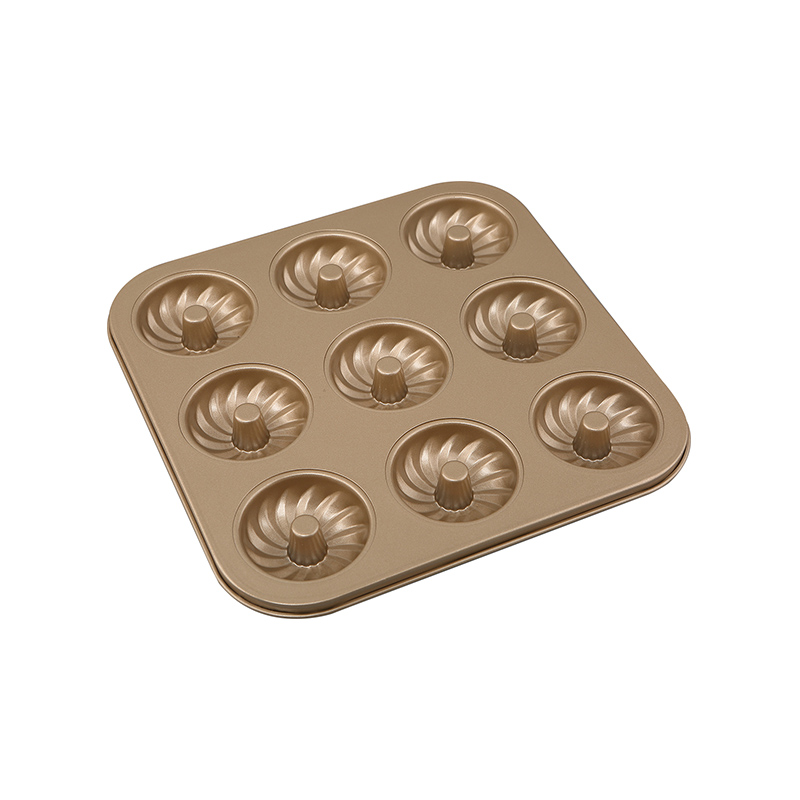
Why Non-Stick Performance Has Become a Production Efficiency Factor
In commercial baking environments, coating quality directly influences productivity, labor cost, and production downtime. When coating performance declines, entire production lines slow down.
Common operational issues include:
- Dough adhesion increasing manual cleaning workload
- Coating peeling after repeated high-temperature cycles
- Uneven release causing deformation of donut shape
- Increased oil spraying consumption per batch
- Frequent tray replacement interrupting production flow
These problems significantly reduce operational efficiency in high-output bakeries.
Evolution of Industrial Food-Grade Coating Systems
Modern baking pan manufacturing has shifted toward multi-layer engineered coating systems rather than single-layer spraying methods.
Key coating improvements include:
- Multi-layer PTFE-based non-stick surface structures
- Ceramic-reinforced coating layers for higher thermal resistance
- Improved bonding technology between metal base and coating layer
- Food-contact compliant coating materials meeting international standards
- Controlled curing process for stronger adhesion stability
These upgrades improve long-term durability under continuous industrial use.
Why Surface Micro-Engineering Matters in Baking Performance
Beyond materials, surface structure design plays a critical role in release performance. Even coating quality cannot compensate for poor surface geometry.
Modern design improvements include:
- Micro-texture surface optimization to reduce contact adhesion
- Smooth cavity edge finishing to prevent batter buildup
- Uniform roughness control across all mold cavities
- Anti-scratch surface reinforcement for automated handling systems
- Improved curvature design for faster product release
These factors help maintain stable release performance over long production cycles.
Thermal Resistance and Coating Stability Relationship
One of the important technical challenges in coating systems is maintaining stability under repeated heating and cooling cycles.
Key engineering considerations include:
- Resistance to thermal cycling between 180°C and 230°C
- Reduced micro-cracking risk under repeated expansion stress
- Enhanced bonding strength between coating layers and substrate
- Anti-oxidation surface protection during long oven exposure
- Controlled cooling tolerance to prevent coating separation
This ensures consistent performance across long-term industrial use.
Cleaning Efficiency as a Hidden Cost Driver
In bakery production, cleaning time often represents a hidden operational cost that directly affects output efficiency.
Coating performance impacts cleaning in several ways:
- Reduced residue buildup after baking cycles
- Faster washing with lower water and detergent usage
- Less manual scrubbing required by operators
- Lower risk of surface damage during cleaning
- Shorter downtime between production batches
Efficient cleaning cycles improve overall production throughput.
What Buyers Expect from a Donut Baking Pan Factory
Global procurement teams now evaluate suppliers based on long-term coating performance rather than only initial appearance or price.
Key purchasing expectations include:
- Verified food-grade coating safety certification
- Long-cycle durability under industrial baking conditions
- Stable release performance over extended production periods
- Resistance to industrial cleaning and sanitizing processes
- OEM coating customization options for different markets
These criteria are now standard in international procurement reviews.
Application in Modern Industrial Baking Systems
Advanced coated baking pans are widely used in high-volume production environments where efficiency and consistency are critical.
Typical applications include:
- Automated bakery production lines
- Centralized commercial baking kitchens
- Frozen baked goods manufacturing facilities
- Franchise supply chain baking systems
- Export-oriented food production factories
Each environment requires stable, repeatable coating performance.
High-Performance Surface Engineering in Baking Tools
The baking industry is moving toward advanced surface engineering systems that combine durability, safety, and automation compatibility. Coating technology is no longer a secondary feature—it is now a core production efficiency factor.
For global buyers and industrial food manufacturers, selecting a reliable Donut Baking Pan Factory has become a strategic decision that directly influences production efficiency, hygiene control, and long-term operational cost.
