
 Language
 English
 中文简体
中文简体 Deutsch
With the rapid expansion of industrial bakery automation worldwide, equipment compatibility has become a major procurement focus. Recent search behavior such as bakery production line tray size standard for conveyor system, donut baking mold robot loading deformation issue, industrial baking pan automation compatibility tolerance requirement, and Donut Baking Pan Factory shows that buyers are no longer evaluating baking pans only by material or coating performance. Instead, dimensional precision, automation adaptability, and mechanical handling stability are now key decision factors in global procurement.
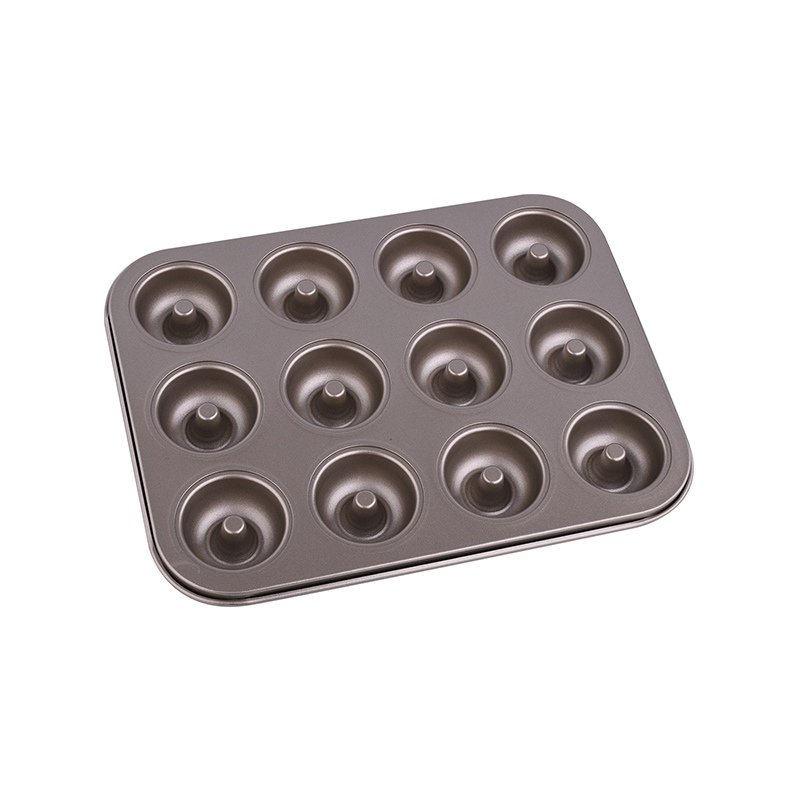
Why Automation Is Reshaping Bakery Equipment Requirements
Modern bakery production lines rely heavily on synchronized mechanical systems, including conveyors, robotic loaders, and automated filling machines. Any deviation in pan dimensions can disrupt the entire workflow.
Common automation challenges include:
- Tray misalignment during conveyor transfer
- Inconsistent cavity spacing affecting filling accuracy
- Jamming issues in robotic gripping systems
- Stack instability during automated loading
- Production interruption due to dimensional deviation
These issues increase downtime and reduce production efficiency.
The Importance of Dimensional Precision in Manufacturing
To meet automation requirements, manufacturers are tightening production tolerances significantly compared to traditional bakeware standards.
Key improvements include:
- CNC-controlled forming processes for higher dimensional accuracy
- Strict cavity spacing calibration across all production batches
- Uniform edge height control to ensure stable stacking
- Automated measurement inspection systems during production
- Batch consistency verification before shipment
This ensures compatibility with automated baking systems.
Structural Reinforcement for Mechanical Handling Systems
In automated environments, baking pans are frequently handled by machines instead of humans, which increases mechanical stress on the structure.
Key engineering upgrades include:
- Reinforced tray edges for robotic gripping stability
- Anti-deformation structural support under repeated handling
- Improved rigidity for conveyor-based transport systems
- Scratch-resistant surface protection for mechanical contact
- Optimized weight balance for automated lifting systems
These improvements reduce failure risk during continuous operation.
Compatibility With Conveyor and Oven Systems
One of the critical requirements in automated baking lines is seamless integration between pans, conveyors, and ovens.
Key compatibility considerations include:
- Standardized tray width for conveyor alignment systems
- Heat-resistant structure suitable for continuous oven cycling
- Smooth edge design for transfer between production stages
- Consistent stacking height for automated loading systems
- Uniform cavity positioning for dosing machine accuracy
This ensures smooth, uninterrupted production flow.
Why Buyers Prioritize System Integration Capability
Procurement teams now evaluate suppliers not only on product quality but also on how well equipment integrates into their production systems.
Key purchasing priorities include:
- Guaranteed compatibility with automated production lines
- High repeatability across large-scale batch production
- Engineering support for custom system requirements
- Reduced manual intervention in production processes
- Long-term dimensional stability under industrial use
These factors directly influence supplier selection decisions.
Application in Global Industrial Bakery Automation
Automated donut baking pans are widely used in modern high-efficiency food production environments.
Typical applications include:
- Fully automated bakery manufacturing plants
- High-volume frozen dough production facilities
- Centralized bakery distribution kitchens
- Franchise production supply chains
- Export-oriented industrial baking factories
Each application requires precise engineering alignment with automation systems.
Fully Integrated Smart Baking Production Systems
The bakery industry is moving toward fully integrated smart production systems where equipment, molds, and automation lines operate in synchronized environments. In these systems, bakeware is no longer a passive tool but an active component of production efficiency.
For global procurement teams and engineering buyers, selecting a reliable Donut Baking Pan Factory is increasingly a decision about automation compatibility, system efficiency, and long-term production stability.
