
 Language
 English
 中文简体
中文简体 Deutsch
In recent years, commercial baking procurement trends have shifted from simple equipment replacement to full production consistency optimization. Across global search behavior, queries such as industrial donut tray heat inconsistency solution, non-stick coating failure in baking pans, high-volume bakery mold deformation issue, and Donut Baking Pan Factory reflect a clear concern: manufacturers and bakery operators are struggling more with production stability than with basic tooling availability. This is especially visible in bakery chains, frozen food producers, and centralized food manufacturing plants where even small variations in baking performance can directly affect product appearance, texture, and batch acceptance rate.
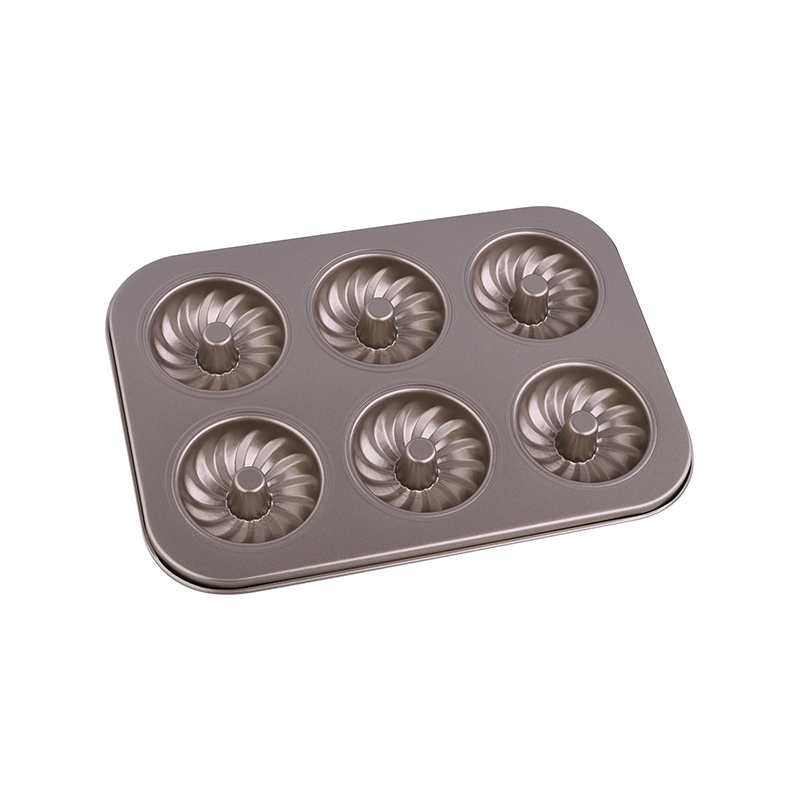
Why Production Consistency Has Become a Core Purchasing Standard
In modern bakery operations, consistency is no longer a “quality advantage” but a baseline requirement. Large-scale production lines depend on identical output across thousands of baking cycles.
Key operational challenges include:
- Uneven heat exposure across multi-cavity baking trays
- Batter sticking that disrupts automated release systems
- Deformation of molds after repeated thermal cycling
- Inconsistent baking color between tray positions
- Increased rejection rates in standardized product lines
These issues directly impact both efficiency and brand consistency, pushing buyers to re-evaluate equipment suppliers.
Material Engineering Behind Modern Donut Baking Pans
The performance difference between traditional molds and modern industrial-grade baking pans largely comes from structural material upgrades. Manufacturers are now focusing on stability under continuous thermal stress rather than only surface appearance.
Key material improvements include:
- Heavy-gauge carbon steel base for structural rigidity under high heat
- Aluminum-enhanced thermal conduction layers for faster and more uniform heating
- Reinforced rim structure to reduce warping during repeated oven cycles
- Food-grade coating systems designed for long-term contact safety
- Anti-oxidation surface treatment to extend service lifespan
These structural improvements help maintain dimensional accuracy even after extended industrial use.
Heat Distribution Engineering for Uniform Baking Results
One of the overlooked but critical aspects of donut production is heat distribution design. Inconsistent heat flow inside baking trays is often the root cause of uneven color and texture differences.
Modern engineering approaches include:
- Optimized cavity spacing to improve air circulation
- Controlled wall thickness for balanced thermal conduction
- Multi-zone heat absorption design to reduce hotspots
- Improved tray geometry to support stable airflow movement
- Structural venting design to enhance oven heat exchange efficiency
This engineering focus ensures each donut receives nearly identical thermal exposure.
Why Non-Stick Performance Directly Impacts Production Efficiency
In high-volume bakeries, coating performance is not just about convenience—it directly affects production speed and labor cost. Poor release performance increases downtime and cleaning frequency.
Key performance requirements include:
- Stable food-grade coating under repeated 180–230°C baking cycles
- Scratch-resistant surface structure for automated handling lines
- Reduced oil dependency for release during production
- Easy-clean surface design to shorten maintenance cycles
- Long-term adhesion stability to prevent coating peeling
A stable coating system significantly improves continuous production efficiency.
What Global Buyers Expect from a Donut Baking Pan Factory
Procurement decisions today are more engineering-driven than ever before. Buyers are evaluating suppliers based on production capability, consistency control, and long-term reliability rather than only unit price.
Key evaluation criteria include:
- Batch-to-batch dimensional consistency for automated lines
- Verified thermal performance under continuous industrial baking conditions
- Compliance with international food contact material standards
- OEM/ODM customization capability for different bakery systems
- Long-term structural stability under repeated thermal cycling
These expectations are reshaping global sourcing strategies for bakery equipment.
Application Scenarios Across Industrial Baking Operations
Modern donut baking pans are widely applied in professional food manufacturing environments where consistency and scale are essential.
Typical applications include:
- Industrial bakery production facilities with automated lines
- Centralized baking kitchens for retail chain brands
- Frozen bakery product manufacturing plants
- Hotel and catering mass production kitchens
- Export-oriented food processing factories
Each of these environments requires stable, repeatable, and scalable baking performance.
Precision-Engineered Baking Tool Systems
The baking equipment industry is gradually moving toward precision-engineered tooling systems designed to support automation, consistency, and reduced operational waste. Instead of being treated as simple bakeware, donut pans are now considered part of integrated production engineering systems.
For global buyers and industrial food manufacturers, selecting a reliable Donut Baking Pan Factory is increasingly a decision that directly affects production efficiency, product consistency, and long-term operational stability.
