
 Language
 English
 中文简体
 Deutsch

Choosing bakeware for commercial doughnut production involves more than checking the cavity shape or appearance. A pan may look suitable during a sample review but perform differently when it is used repeatedly, cleaned frequently, and handled as part of a busy production process. For overseas buyers working with Donut Baking Pan Manufacturers, a more practical evaluation should consider construction, surface condition, dimensional consistency, handling, and compatibility with the intended baking process before moving to larger orders.
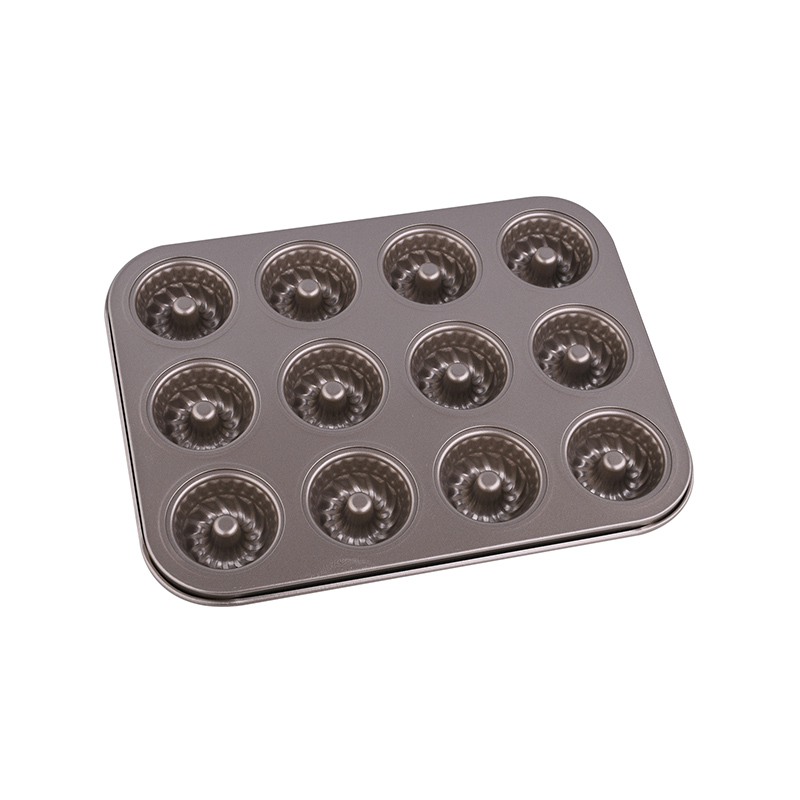
Start With the Intended Baking Application
The step is to define how the pan will actually be used. A bakery producing traditional ring doughnuts may have different requirements from a foodservice operation developing mini or seasonal products.
Before selecting a pan, buyers can clarify:
- Target doughnut size and shape
- Recipe and batter characteristics
- Oven type and available baking space
- Expected baking frequency
- Cleaning method
- Storage conditions
- Manual or automated handling requirements
Providing this information helps manufacturers recommend or develop a pan based on application rather than appearance alone.
Examine Material and Structural Design
The material affects how the pan handles heat, weight, deformation, and repeated use. However, material selection should not be considered separately from the overall construction.
Pan thickness, cavity arrangement, edges, supporting structure, and flatness can all influence practical handling. A commercial buyer should therefore examine whether the pan feels stable during loading, transport, baking, and removal from the oven.
For manufacturers, consistent forming and finishing are equally important because variations in structure can affect how the pan sits and performs during production.
Check Cavity Consistency Carefully
When several cavities are included on one pan, consistency between them matters. Differences in cavity dimensions can advance to variations in doughnut shape, size, or baking behavior.
During sample evaluation, buyers can compare cavities rather than checking only one area of the pan. Attention should be given to the center opening, depth, edges, and transitions between the cavity and surrounding surface.
This is especially useful for commercial bakery buyers who need products with a consistent appearance across repeated batches.
Look Beyond the Coating Surface
A nonstick surface can make doughnut removal easier, but buyers should not judge surface treatment only by how smooth the pan looks when new.
The intended recipe, baking conditions, cleaning process, and handling method all influence how a surface performs in practice. Commercial users should understand the manufacturer's recommended care requirements and confirm that these requirements fit their daily workflow.
A practical sample evaluation can include:
- Ease of doughnut release
- Residue left after baking
- Cleaning effort
- Surface condition after normal handling
- Compatibility with the intended baking process
This provides more useful information than a visual inspection alone.
Consider Cleaning and Storage From the Beginning
Commercial bakeware is handled repeatedly, so maintenance should be part of the purchasing decision. Difficult-to-clean areas can increase routine workload, while unsuitable storage can cause unnecessary surface or structural damage.
Buyers should consider how the pan will be washed, dried, stacked, transported, and stored between production cycles. Manufacturers can also provide useful guidance on handling practices that help maintain the pan's intended condition.
A pan that fits the existing maintenance process is generally easier to integrate into daily bakery operations.
Use Samples to Check Production Compatibility
A sample order is an opportunity to evaluate more than dimensions. It allows buyers to observe how the pan behaves with their own recipe and equipment.
During testing, procurement and production teams can record practical observations such as:
- Batter distribution across cavities
- Finished doughnut consistency
- Release performance
- Baking uniformity
- Ease of handling
- Cleaning after use
- Any visible changes to the pan surface
These observations can then be discussed with the manufacturer before confirming a larger production order.
Evaluate the Manufacturer, Not Just the Pan
For overseas buyers, the supplier's manufacturing process can be as important as the sample itself. A capable manufacturer should be able to communicate clearly about materials, forming, surface treatment, dimensional control, inspection, packaging, and customization.
From a manufacturer's perspective, understanding the buyer's application before production helps reduce unnecessary specification changes and makes communication more precise. This is particularly valuable when a customer requires a custom cavity layout, specific dimensions, or a private-label production solution.
Make the Final Decision Based on Real Use
A commercial baking pan should be evaluated according to how well it fits the complete production process rather than how attractive it looks in a product catalog. Construction, cavity consistency, surface treatment, cleaning, storage, and application compatibility all influence long-term usability. For overseas buyers comparing Donut Baking Pan Manufacturers, testing samples under realistic production conditions and communicating the intended application clearly can make sourcing decisions more practical and help establish a suitable bakeware solution for ongoing doughnut production.
